 Wobo Industrial Equipment Co., Ltd.

CONTACT US


Product Overview
The CO₂ electrolysis process is an advanced carbon utilization technology that integrates CO₂ enrichment, electrochemical conversion, and product separation into a single system.
Through a modular design, CO₂ from low-concentration flue gas can be directly captured and converted into high-value chemicals, significantly reducing intermediate processing steps. The overall process is compact and efficient, lowering raw material costs while improving conversion efficiency, and providing a green, sustainable solution for carbon reduction and resource utilization.
Working Principle
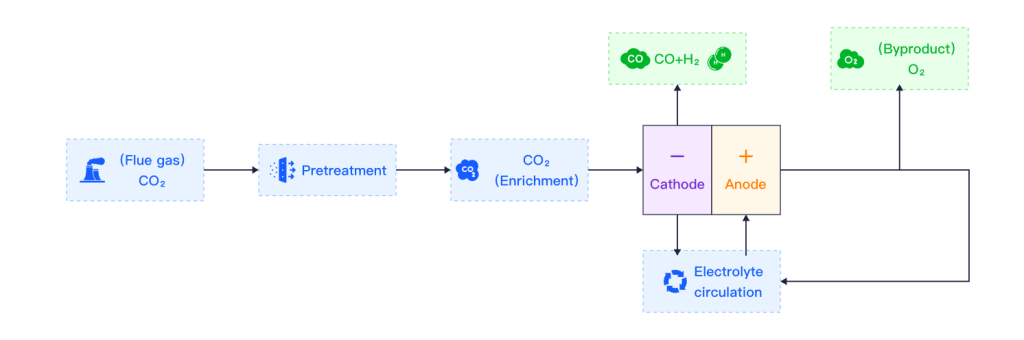
The process is based on electrochemical reduction. Under an applied electric field, enriched CO₂ is introduced into the electrolysis unit.
At the cathode, CO₂ is reduced to produce carbon-based products such as carbon monoxide, formic acid, and methanol, while oxidation reactions occur at the anode to maintain charge balance.
A gas enrichment module increases the CO₂ concentration in the feed stream, followed by a high-efficiency electrolysis unit for rapid conversion. A downstream separation module then purifies and recovers the products.
The close integration of these modules minimizes transfer losses and enhances overall energy efficiency and conversion performance, enabling continuous transformation from low-concentration CO₂ to high-value products.
Key Features
- Integrated Modular Design: Efficient coordination of enrichment, electrolysis, and separation for high overall performance.
- Direct Use of Flue Gas: Utilizes low-concentration CO₂ directly, reducing production costs and improving resource efficiency.
- Green & Safe Process: Operates via electrochemical pathways without the need for high temperature or high pressure conditions.
- High Conversion Efficiency: Converts CO₂ into a variety of valuable chemicals while significantly reducing carbon emissions.
- Compact & Scalable: Designed for easy scale-up and flexible deployment across multiple application scenarios.
Applications
- Flue Gas Treatment: Applied in power plants, steel mills, and other industrial emission sources to capture and convert CO₂ efficiently.
- Chemical Industry: Provides a sustainable carbon source for producing chemicals such as formic acid and methanol.
- Energy Sector: Supplies green feedstock for energy storage materials and fuel cells, supporting the transition to low-carbon and clean energy systems.